
Recipe · Sandwich Loaves
Fresh Milled Rosemary Garlic Sandwich Bread
By: Eleen Beisner
Soft, savory, and full of flavor, this fresh milled rosemary garlic sandwich bread is made with hard white wheat and spelt for a tender crumb that still has enough structure for beautiful sandwich slices. Fresh rosemary and roasted garlic give the loaf plenty of flavor without overpowering the mild, slightly sweet fresh milled wheat.
Prep time: 3–4 hours · Bake time: 30–36 minutes · Yields: 1 loaf
Ingredients
Fresh Milled Flour
- 400 g hard white wheat berries
- 80 g spelt berries
- 12 g vital wheat gluten (about 1½ tablespoons), optional
Dough
- 160 g whole milk (about ⅔ cup)
- 125 g water (about ½ cup + 1½ teaspoons)
- 1 large egg (about 50 g)
- 25 g olive oil (about 2 tablespoons)
- 45 g sugar (about 3½ tablespoons)
- 8 g instant yeast (about 2½ teaspoons)
- 9 g fine salt (about 1½ teaspoons)
- 2 tablespoons finely chopped fresh rosemary
- 35 g roasted garlic from 1 whole head of garlic, mashed (about 2½ tablespoons)
For Finishing
- Melted butter or olive oil, optional
Instructions
Roast the Garlic
Preheat oven to 425°F. Slice the top off the garlic head to expose the cloves. Drizzle with olive oil, wrap in foil or place in a covered baking dish, and roast for 30–35 minutes, or until very soft.
Allow to cool slightly, then squeeze the garlic from the skin and mash. Measure 25–30 g (about 1½ Tbsp) for the dough and set aside.
Mill the Wheat
Mill the hard white wheat and spelt berries on a fine setting.
Hydrate the Flour
Add the freshly milled flour, vital wheat gluten (if using), milk, water, egg, olive oil, and sugar to the bowl of a stand mixer.
Mix until everything is combined and no dry flour remains.
Cover and allow the mixture to rest for 20–25 minutes.
Knead the Dough
Add the instant yeast, salt, rosemary, and roasted garlic.
Knead until the dough has developed good gluten strength. Allow approximately 8–25 minutes total for kneading, depending on your mixer. Watch the dough rather than following an exact time—it should become stretchy, elastic, and smooth.
The finished dough should be very soft and slightly tacky but should still hold its shape.
First Rise
Cover the dough and allow it to rise in a warm place until approximately 75–100% larger, about 60–90 minutes.
Watch the dough rather than the clock, as rising times will vary depending on the temperature of your kitchen.
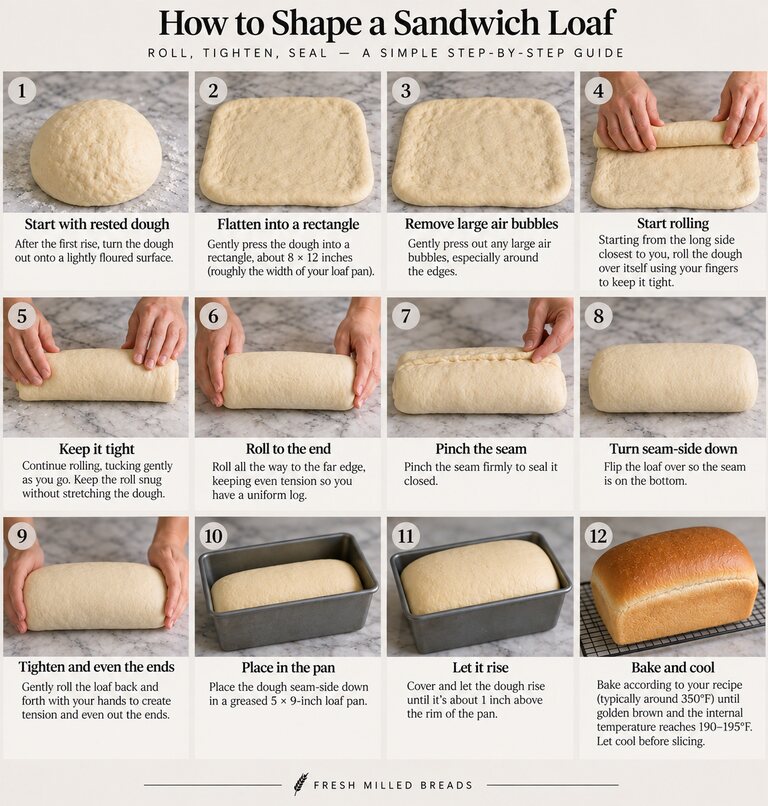
Shape the Loaf
Grease a 5 × 9-inch loaf pan.
Gently press the dough into a rectangle approximately the width of the loaf pan.
Starting at one end, roll the dough snugly into a log, gently pressing out any large air pockets as you roll.
Pinch the seam closed.
Place the loaf seam-side down in the prepared pan.
Final Rise
Cover and allow the loaf to rise until the center of the dough is approximately 1 inch above the rim of the pan. This could happen anywhere between 45–90 minutes, watch the dough rather than the clock.
Bake
Preheat the oven to 350°F.
Bake for 30–36 minutes, or until the loaf is golden brown and the internal temperature reaches 190–195°F.
If the top begins browning too quickly, loosely cover it with foil for the remainder of the baking time.
Cool
Allow the bread to cool in the pan for 5–10 minutes, then transfer it to a wire cooling rack.
For an extra-soft crust, lightly brush the warm loaf with melted butter or olive oil.
Allow the bread to cool completely before slicing.

Baker's Notes
Hard white wheat provides the strength and structure needed for a tall sandwich loaf while keeping the wheat flavor mild.
Spelt adds tenderness and a subtle sweetness to the crumb.
Vital wheat gluten gives the fresh milled dough extra strength, helping it hold onto the gases produced during rising. This helps the loaf rise taller and gives the finished bread a lighter, softer crumb instead of becoming dense or heavy.
Roasted garlic gives the bread a mellow, savory garlic flavor without the sharpness of raw garlic.
Avoid overproofing the final loaf. Bake when the center of the dough has risen about 1 inch above the rim of the pan.
Let the loaf cool completely before slicing for the cleanest sandwich slices.
Storing & Freezing
Storing
Allow the loaf to cool completely before storing. Keep it in an airtight container or bread bag at room temperature for 2–3 days. For the softest texture, avoid refrigerating the bread, as refrigeration can cause it to dry out more quickly.
Freezing
Once completely cool, wrap the whole loaf tightly or slice it first for easier serving. Place in a freezer-safe bag or container and freeze for up to 3 months.
Thaw at room temperature while still wrapped to help keep the bread from drying out. To refresh the loaf, warm it in a 300°F oven for about 5–10 minutes. Individual slices can also be warmed briefly in the toaster or microwave.
Nutrition Information
About 16 servings per recipe · Serving size: 1 slice (approximately 55 g)
Calories: 150
- Total fat: 3.5 g
- Saturated fat: 1 g
- Trans fat: 0 g
- Cholesterol: 15 mg
- Sodium: 230 mg
- Total carbohydrate: 26 g
- Dietary fiber: 3 g
- Total sugars: 4 g
- Added sugars: 3 g
- Protein: 6 g